The Rehearsal Question That Opens a Scene
A playable rehearsal question helps a stuck scene move by clarifying its immediate stakes, useful objects, and changing conditions without prescribing emotion.
A scene can go flat because its performers have no practical reason to change what they are doing. A playable rehearsal question can restore movement by pointing attention to an immediate condition: what must be handled, hidden, remembered, or decided before the moment ends.
That is different from asking actors to display a feeling or pursue a broad objective. The question should make the scene’s circumstances more specific, so the performers can test how those circumstances shape timing, attention, and use of the space.
Ground the rehearsal question in a concrete condition
Start with what is physically and factually present. A ringing phone, a half-packed suitcase, a letter left open, or a door that will not stay shut can give the scene a problem the actors can encounter together. The object is not decoration; it changes what can happen next.
Ask what condition the scene depends on. Does one character need the letter to remain unread? Is the suitcase supposed to look untouched? Does the phone have to be answered before a third person arrives? These questions keep the work tied to the script’s circumstances instead of turning every exchange into a contest of persuasion.
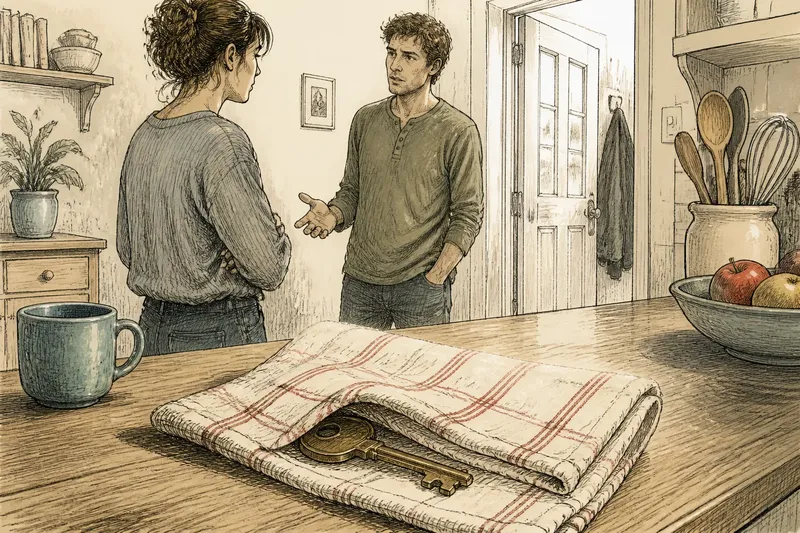
Say you are rehearsing a scene in a kitchen where a character has hidden a key under a folded towel. The scene feels static, so the director asks, “Can the towel stay exactly where it is until the visitor leaves?” The actors can then test where they stand, what they notice, and how a hand approaches the counter; the observable result is that small movements acquire a practical consequence without anyone being told to look suspicious.
Use an observation and a decision to shape the next pass
A useful rehearsal prompt gives the cast something to observe and a clear decision if the observation changes. Keep the question narrow enough to work on in one pass, then note what actually altered in the scene.
- If an object disappears from attention: Check whether the script gives it a consequence. If it does, place it where the actors can see and handle it, then run the beat again; if it does not, remove it from the prompt rather than inventing importance.
- If a prop creates busywork: Check whether each handling action changes what another character knows or can do. If it does, retain the action; if it does not, simplify the business and let the actors focus on the exchange.
- If entrances feel arbitrary: Check what the entering character can hear or see before coming in. If that information matters, adjust the timing or position so the entrance follows from it; if not, keep the existing entrance and avoid adding a hidden motive.
- If a pause feels empty: Check what is unresolved at that moment. If a choice or task remains, give the pause room for that work; if nothing remains, shorten it rather than asking actors to fill it with generalized tension.
- If a discovery arrives too early: Check which line, object, or movement reveals the information. If the script supports delaying that discovery, alter the timing and observe whether the later moment becomes clearer; if the text requires the reveal, restore its original timing.
- If the space seems underused: Check which locations matter to the scene’s facts. If crossing to a particular place changes access, privacy, or visibility, try that route; if the geography adds no consequence, keep the blocking simple.
These are decisions about the conditions of the scene, not a recipe for adding activity. A chair can remain a chair. It need not become a metaphor with a union card.
Choose a question that tests one stageable variable
When a scene stalls, identify one variable that can be adjusted without rewriting the scene: the timing of an entrance, the visibility of a prop, the distance between two people, or the point at which a task is interrupted. Change one thing at a time so the cast can tell what affected the rhythm.
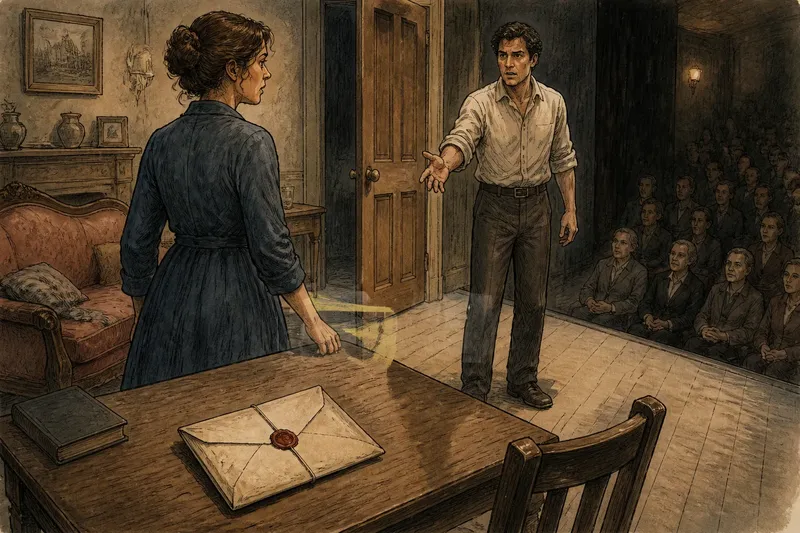
For example, a director might ask, “What changes if the envelope stays on the table until the final exchange?” The actors can run the scene with that condition, then compare whether the envelope draws attention too soon, disappears completely, or gives the last exchange a sharper focus. If the result is unclear, the next pass can test a different condition rather than layering on several new instructions.
Keep the question within the script’s established facts. If the text says a character has not read the note, do not ask the actor to play as though they know its contents. If a door is locked in the scene, the staging should preserve that fact unless the production has deliberately changed it.
What rehearsal question helps with timing and props?
How do I choose a prop to focus on?
Choose a prop already named, handled, or made consequential by the scene. Ask what changes if it is visible, covered, moved, or left untouched, then keep the version that supports the text without creating unnecessary business.
What should I ask when an entrance feels late?
Ask what the entering character can hear, see, or know at each possible entrance point. Test the point that follows the scene’s information, and retain the original timing if a change makes the character’s knowledge inconsistent.
Can a rehearsal question be about space?
Yes, if the location changes access, privacy, or visibility. Try a specific adjustment—such as moving one character from the doorway to the table—and watch whether it clarifies the scene’s geography or merely adds blocking.
When should I stop adjusting a prompt?
Stop when the question gives the performers a clear condition and the scene’s next beat is understandable. If further adjustments produce no visible difference, return to the script’s simplest playable version.
Work through a full pass without changing the script
Imagine a scene with two siblings, a packed suitcase, and a visitor expected at the front door. The script establishes that one sibling has packed, the other has not yet noticed, and the visitor’s arrival ends their private conversation. In the first pass, the suitcase stays open beside the table, but neither actor uses it and the ending feels unmotivated.
The director chooses one condition: “Can the suitcase remain open until the visitor knocks?” The actors run the scene with that condition. One sibling places a folded coat inside, the other notices the empty space beside it, and the knock interrupts an unfinished packing decision; the result is a visible link between the suitcase and the ending, without adding dialogue or assigning either sibling an emotion.
Next, the director checks the script’s facts. If the sibling who has not noticed the suitcase would already have seen it from their position, the blocking must change or the prompt should be abandoned. The useful result is not a more dramatic suitcase; it is a version of the scene whose physical arrangement supports what the text says.
Let the stage picture clarify the scene’s facts
A rehearsal question should make an audience’s view of the scene clearer, not turn the staging into a puzzle. If an object matters, make its presence and handling readable. If a pause depends on someone hearing a sound from offstage, give the audience a fair chance to understand why the pause occurs.
Try the staging from the back row, where small gestures and quiet prop business may disappear. If a decision depends on a detail that cannot be seen or heard, adjust the placement, timing, or emphasis; if it remains legible, resist adding a gesture merely to underline it.
The best playable rehearsal question is often a plain one about a plain condition: what must stay put, what can be seen, or what changes when someone arrives. For a scene that has gone still, the rehearsal question can focus the next pass on one concrete fact and give the cast a useful way to decide what belongs onstage.