The Prop That Steals the Scene
Give a stage prop one clear dramatic function, so its handling sharpens the scene and keeps the audience’s attention on the performers.
A stage prop steals a scene when the audience has to track its jobs instead of the people using it. Decide what the prop changes in the action before choosing its color, finish, or charming extra business.
An object can be useful, evocative, and beautiful without being effective in performance. The practical question is narrower: what changes in the scene because this object is present?
Give the stage prop one dramatic job first
A stage prop’s dramatic function is the specific work it does in the action. It might enable a character to make a choice, expose a disagreement, delay an answer, establish authority, or leave evidence that cannot be ignored. “It makes the room feel lived in” is a scenic impression, not yet a dramatic job.
That distinction does not mean every object needs a grand symbolic burden. A mug may let an actor pour a drink while refusing to answer a question. The refusal is the action; the mug gives it a visible form. If the scene would play the same way without the mug, it may be decoration rather than an active prop.
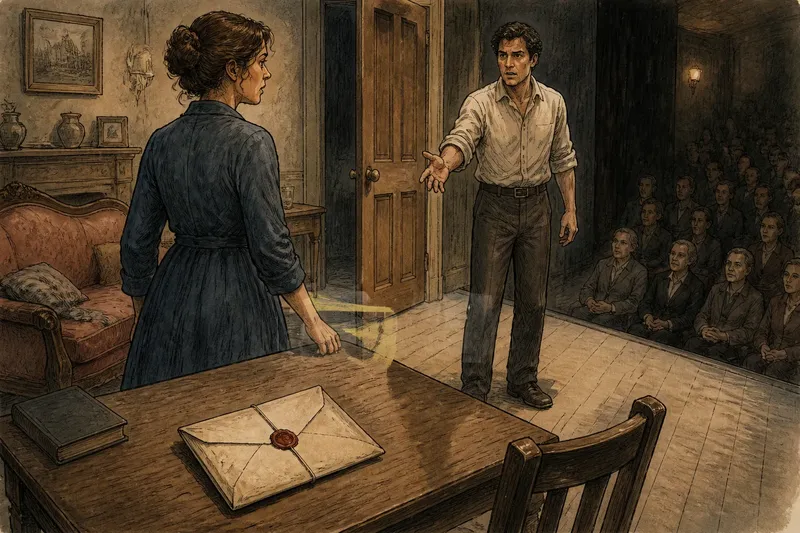
Describe the object’s job with a verb and an outcome: “The envelope forces Mara to decide whether to open it in front of her brother.” That sentence gives the performer something to pursue and the director something to stage. “The envelope represents secrets, family, and the past” gives the object a committee, not a job.
Keep competing functions in a clear hierarchy
The trouble begins when an object is expected to do several unrelated things at once. A key might open a door, prove loyalty, mark a change of location, become a weapon, and carry a childhood memory. Any one of those functions could support a scene. Together, they can leave the audience wondering which meaning to watch.
Multiple uses are not automatically a problem. One object can gather meaning as the action develops, especially when each new meaning grows from what the characters have already done with it. Accumulated meaning feels earned through the scene; assigned meaning arrives because the script keeps announcing another symbolic duty.
When functions compete, choose a hierarchy. One job should carry the action in the present moment. Other associations can remain quiet or be removed. If the object must explain the setting, reveal backstory, produce a gag, mark a transition, and trigger the climax, the scene may be avoiding a clear choice.
Make the prop’s dramatic function visible to the audience
A dramatic function needs a visible or audible consequence. A character hides a letter, and someone else searches for it. Someone sets down a glass instead of drinking, and the negotiation changes pace. A prop that matters only because the playwright knows its private meaning may not register from the seats.
That does not require explaining every object in dialogue. The audience can infer a function from handling, timing, resistance, and the reactions of other performers. A locked box becomes legible when someone tries to open it, is stopped, and changes tactics.
Check the action by temporarily removing the object in rehearsal. What becomes impossible, less clear, or less tense? If nothing changes, the prop has not yet earned its place in the scene. Cut it, or give it one concrete action that affects the relationship.
Let decorative detail follow the action
Once the central function is settled, appearance can help the audience read it. A prop’s size, material, sound, and condition influence how it moves and how much attention it attracts. A metal lunch tin clatters when set down; a folded paper note disappears into a pocket. Those qualities help when they support the chosen action.
Decorative detail distracts when it introduces a question the scene does not intend to answer. A bright red suitcase may pull focus even if it is meant to sit untouched. A prop covered in labels may invite the audience to read them. If neither response serves the scene, simplify the object or change how it is presented.
Consider the audience’s line of attention. A performer’s face, a sudden movement, and a conspicuous sound compete for notice. The stage picture need not be bare, but each prominent feature should have a reason to take focus at that moment. A useful prop can remain visually quiet until the action calls for it.
How can you tell if a prop is doing too much?
What separates a prop from decoration?
A prop affects the action through handling, consequence, or a change in what a character can do. Decoration shapes the setting without changing the scene’s choices. An object may shift between those roles, but the production should know which role matters most in a particular moment.
Can one prop carry more than one meaning?
Yes, if the additional meaning grows from the action rather than arriving as a separate assignment. A keepsake can begin as something a character protects and later become evidence of a lie. The audience can follow that shift when the object’s history becomes visible through what the characters do with it.
Does an actor have to handle every prop?
No. An object can establish a practical condition, such as a table set for someone who never arrives. But if it draws the eye, its presence should contribute to the audience’s understanding. Unhandled does not mean irrelevant; the staging still needs to make its relevance clear.
When should you cut a prop?
Cut it when its presence adds business but no useful change, or when another element already performs its function more clearly. Before removing it, check whether the scene depends on an action the object enables. Make the decision according to what the audience needs to see, not an attachment to a clever item.
Check a prop’s job before adding detail
- Observe whether the prop enables a character’s choice; if it does, keep it for that action, and if it does not, remove it or assign a concrete action that changes the scene.
- Observe whether another object already performs the same job; if one prop is clearer, cut the duplicate, and if each creates a distinct consequence, keep both and clarify their separate moments.
- Observe whether the audience can see or hear the prop’s consequence; if the action reads, retain the staging, and if it does not, make the handling or reaction clearer rather than adding dialogue by default.
- Observe whether a decorative feature pulls focus at the wrong moment; if it does, simplify or reposition the prop, and if it supports the intended focus, keep the feature.
- Observe whether performers can handle the object without interrupting the scene; if they can, keep the arrangement, and if they cannot, change the prop or its placement.
- Observe whether removing the prop changes the choices, tension, or clarity; if it does, retain it, and if nothing changes, cut it or give it one visible dramatic job.
Say you are staging an invented scene in which a tenant must return a borrowed key before the landlord arrives. The key’s job is to force a choice: admit the door was left unlocked or hide the mistake. First, identify that choice; next, stage the tenant hiding the key, then hesitating when a knock sounds. Finally, compare the moment with a plain key and a key ring shaped like a tiny house. If the ring draws attention without affecting the choice, use the plain key; the expected result is that the audience follows the tenant’s hesitation rather than the ornament.
For your scene, write one sentence naming the prop’s main job, then identify the visible action that carries it. Decide what the audience should notice and what should remain in the background. Choose texture, color, wear, or ornament only after those decisions are settled.
Watch the scene from a seat rather than beside the prop table. Notice whether the object draws attention at the intended moment, whether performers can handle it without awkward explanation, and whether it changes the action. A stage prop earns its place not by how much it can mean on paper, but by how clearly it helps the audience see what is happening.