A Premise That Fits on One Page
A one-page performance premise clarifies the situation, intended change, and main constraint so collaborators can make early writing choices without fixing the ending.
A one-page performance premise helps when an idea keeps producing more possibilities than a first draft can hold. Name the central situation, the change the performance is meant to bring about, and the main constraint shaping it; those choices give collaborators something specific to question without pretending the work is solved.
Keep the page provisional. It is not a pitch deck, a treatment, or a miniature script, but a working account of what the piece is trying to make happen. Eight distinct parts can clarify the idea while leaving room for discovery.
State the situation as something happening now
Begin with a situation, not a theme. “A performance about loneliness” names a subject, but it does not tell a performer what is occurring, what can change, or why the audience is watching. A situation gives the idea a present tense and a pressure point.
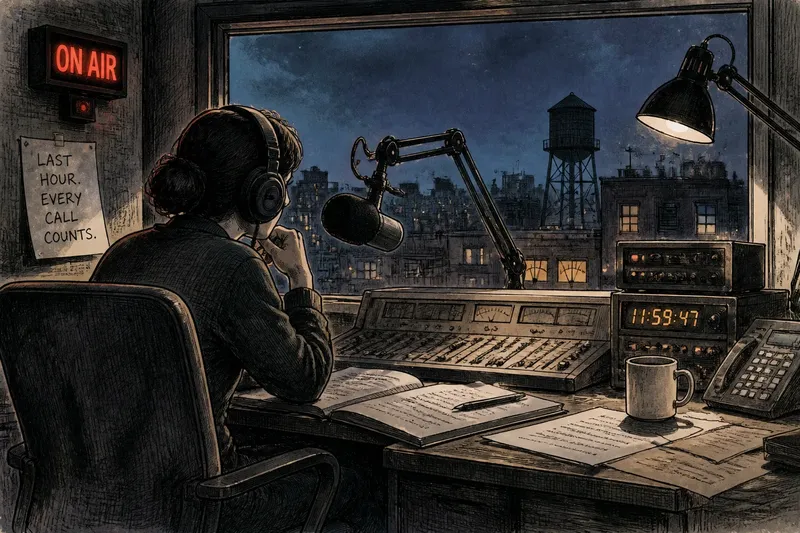
Try a sentence with a person or group, a circumstance, and an unresolved condition: “During the final hour of a neighborhood radio station, its overnight host must decide what to do with a caller who will not hang up.” The sentence does not settle the ending. It establishes a place, a time-bound condition, and a problem the performance can keep working on.
Choose details that affect action rather than decorate the premise. A radio station matters if its equipment, broadcast rules, or live audience shape what can be done. If changing the location would leave every action untouched, the location may be atmosphere rather than part of the situation.
Identify who has to act
A premise becomes playable when someone must make choices inside it. That person need not be a conventional protagonist: it could be an ensemble, a chorus, a committee, or a performer shifting among several roles. The page should still make clear whose decisions carry the piece.
Describe the central figure by what they are responsible for, not by a catalogue of traits. “The host is charming, anxious, and secretly ambitious” offers characterization before the work has established what those qualities do. “The host controls the microphone and must decide whether to keep the caller on air” defines a role through agency.
If the performance depends on several people, name their relationship to the decision. A group may share authority, disagree about it, or lack the power to act without one member’s consent. The premise need not specify every relationship; it should show where responsibility gathers.
Name the intended change
Write down what you want to be different by the end. This is not a demand for a tidy moral or a fixed plot twist. It distinguishes a performance that changes its situation from one that simply circles a subject.
The change might be practical, relational, or perceptual. The host may have to choose whether to end the broadcast; two performers may stop treating a shared task as neutral; an audience may see an ordinary procedure as a form of control. State the change as an observable shift, then leave open how the work earns it.
Separate intended change from the audience’s presumed response. “The audience will feel hopeful” is difficult to use as a writing decision and impossible to demand from a room. “The host moves from withholding a decision to making one in public” gives the team an action to shape and gives spectators room to respond differently.
Choose the main constraint
A constraint is a condition that meaningfully limits the work. It may be a single room, an uninterrupted broadcast, a fixed performer arrangement, an audience seated among the action, or a rule that no character can leave. Pick the condition with the strongest effect on what the piece can do.
Do not list every production preference as though all constraints were equally central. A page crowded with limits starts to resemble an inventory, and an inventory does not tell the team which limits generate the idea. Name one primary constraint, then mention a secondary condition only if it changes the central situation or intended change.
Imagine the radio-station piece without its uninterrupted broadcast. If the host can pause, leave the room, and consult someone offstage, the public pressure of the decision changes; the broadcast belongs on the premise page. If removing a preferred chair leaves the action intact, the chair can wait for production notes.
Describe the audience’s position
Say what the audience can know, see, or be asked to do. “The audience is involved” is not precise enough to guide the work. They might hear a conversation they cannot interrupt, watch a task from close range, or make a choice that alters what performers do next.
Audience position is not the same as audience emotion. A premise can propose that spectators witness a decision without announcing that they will admire, fear, or forgive the person making it. Such claims blur a useful staging question with a prediction no one can control.
If spectators are asked to act, state the scope of that action in plain language. They might select between prepared options or contribute a short response. The premise does not need to design the interaction in detail, but it should reveal whether audience participation is central or merely an optional device.
Mark what the page does not decide
A premise needs boundaries as well as commitments. Note which questions remain open because answering them now would force premature choices: the exact ending, the order of scenes, or whether the caller is heard in person or through a speaker. These are useful uncertainties, not omissions to disguise.
Keep the open questions selective. If every major feature is undecided, the page has not clarified the idea. If nothing is open, the premise may be smuggling in a finished plot under a modest title. A good working page says both what the team can rely on and what it is still permitted to discover.
Say you are shaping the radio-station premise and have not decided whether the caller is one person or a recorded voice. Keep that choice open, while stating that the host must decide whether to end the broadcast. The expected result is a page that guides early writing toward a public decision without fixing the caller’s identity or the ending.
Check whether each sentence earns space
Read the page sentence by sentence and ask what each one helps a collaborator decide. A line may establish the situation, clarify responsibility, define a constraint, or mark an unresolved question. If it only repeats that the work is urgent, strange, intimate, or important, it is probably not doing enough.
Prefer concrete verbs to promotional adjectives. “The host delays, screens, and finally answers the caller” gives a writer several actions to examine. “A bold and haunting encounter unfolds” gives the reader an atmosphere and no usable information; it also sounds like a description written by someone already standing outside the rehearsal room.
Use compact wording, but do not pursue brevity at the cost of meaning. The one-page limit is a test of selection, not a reason to turn the premise into cryptic shorthand. A performer or designer who was not present for the original conversation should still understand the central situation and the main condition shaping it.
Use the page to begin a useful conversation
Once the premise is written, share it with a small group of collaborators and listen for differences in interpretation. Ask what they believe the central decision is, what must change, and which constraint most affects the action. If their answers diverge, revise the page before trying to settle every disagreement through additional explanation.
The goal is not identical mental pictures. Performers may imagine different tactics, and designers may see different ways to make a room serve the situation. The page has done its job if those differences can be explored within a shared frame rather than arising from incompatible assumptions about what the performance is.
Turn the conversation into a next decision
End the first discussion by naming one decision the team can make now and one question that should remain open. That distinction keeps the page useful after collaborators have responded; it also prevents every disagreement from becoming an emergency meeting about the ending.
For the radio-station premise, imagine three collaborators reading the page. One thinks the host’s decision concerns the broadcast, another thinks it concerns whether the caller is heard, and a third assumes the audience will choose. They reread the sentence about the host controlling the microphone and keeping the caller on air, then agree that the host owns the immediate decision; they leave the caller’s identity and the audience’s role unsettled. The resulting next move is to draft a scene in which the host must choose whether to keep the line open, not to decide how the piece ends.
A one-page performance premise should steer the next creative decision without prescribing every decision after it. Use the phrase “one-page performance premise” as a test of scale, not a demand for tiny type: if a new collaborator can identify the situation, the responsible action, the intended change, the main constraint, and the open question, the page has given the work a clear place to begin.