Dialogue or Direct Address: Choosing a Way to Speak
Compare dialogue and direct address in a short scene to see which form makes its essential information clear and its audience relationship more compelling.
Dialogue or direct address determines how a short scene gives its audience information: through an exchange between characters or through a speaker addressing the room. To choose between them, hold the scene’s events steady and compare what each form asks the audience to watch.
This is a form-selection exercise, not a rehearsal for stronger tactics. Keep the characters’ actions and essential facts intact; change who receives the words, and notice how that redirects attention.
Separate the scene’s facts from its delivery
Write down what the audience must understand by the end of the scene, then mark which facts each character already knows. Keep the list focused on information that affects the scene’s outcome: what has happened, what is at stake, and what changes.
Now note how the audience might receive each fact. A fact can emerge in an exchange, be disclosed directly, or already be visible in an action. This inventory helps distinguish a form problem from a missing-information problem.
If a fact is clear from what a performer does, repeating it in speech may slow the scene. If the audience needs information that no visible action can convey, the speaking form determines who supplies it and what the audience learns about that speaker in the process.
Draft two versions with the same events
Write one version as dialogue between characters. Let each person speak from what they know, and avoid adding background solely to fill the audience in. Then write the same scene as direct address, with one character speaking to the audience while the events remain unchanged.
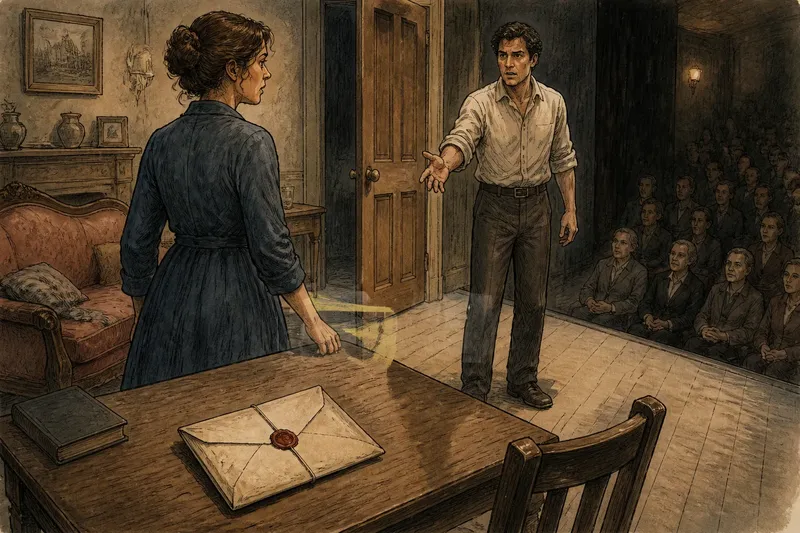
For the direct-address version, decide who the audience is within the scene’s logic, if anyone: witnesses, confidants, a jury, or simply the room. The choice affects the audience’s position. A speaker addressing witnesses may sound accountable; a speaker addressing confidants may seem to expect sympathy.
Do not polish either version yet. The comparison is more useful when differences in delivery can be traced to form rather than to a new plot detail or a more elegant sentence.
Compare what the audience watches
Read each draft aloud, then make a brief note about where attention went. In the dialogue version, did the audience follow the exchange between characters, or spend time working out a fact? In direct address, did attention stay on the speaker’s account, or keep returning to the visible scene?
These forms distribute attention differently. Dialogue places information among speakers, where a pause, interruption, or silence can matter. Direct address makes the speaker’s selection of information more prominent, but can compete with a visible action if both ask to be watched at once.
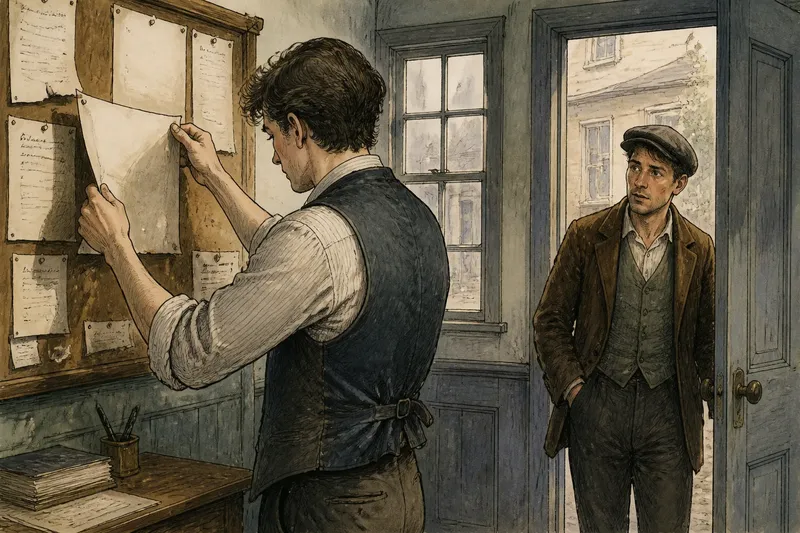
Say a scene begins with a clerk removing a shared notice from a wall, and the neighbor arrives before the clerk can leave. In a dialogue draft, the neighbor asks why the notice is gone and sees the clerk hesitate; the audience follows the exchange and may infer that the answer is incomplete. In a direct-address draft, the clerk tells the audience why the notice was removed while the neighbor waits; the audience receives the reason directly and watches the clerk’s divided attention. The events stay the same, but the first version foregrounds the exchange and the second foregrounds the account.
Use a seven-day comparison without compressing the decision
A week-long comparison works best when each stage has room to produce something the next stage can use. Keep the two drafts and the audience-attention notes together, so the choice rests on the scene’s effect rather than on which version sounds more polished on first reading.
- Day one: List the essential facts, the characters who know them, and the scene’s visible actions.
- Day two: Draft the scene as dialogue without changing its events.
- Day three: Draft the same scene as direct address, keeping the facts and events steady.
- Day four: Read both versions aloud and note what the audience must watch or infer.
- Day five: Compare the notes and choose the form that best directs attention to the scene’s central pressure. If the results are mixed, record what remains unclear rather than choosing early.
- Day six: Revise the selected draft, removing information already conveyed by action and clarifying any fact the audience still needs.
- Day seven: Read the revised scene aloud. Check whether the audience can follow the essential information and whether attention lands where the scene intends.
Imagine a playwright’s two drafts both include a clerk taking down a notice and a neighbor arriving. The dialogue draft makes the neighbor ask about the removal, while the direct-address draft lets the clerk give the audience the reason before answering the neighbor. On day four, the playwright notes that the dialogue version makes the audience wait for the answer, while the direct-address version supplies it early; on day five, they choose dialogue because the delay is the scene’s central pressure. They revise that version on day six to remove a line repeating the clerk’s action, then read it on day seven to check that the audience can follow the dispute without an extra explanation. Those choices are invented, but the sequence shows how to keep comparison, selection, revision, and final reading distinct.
Which form suits the scene’s audience relationship?
What does dialogue let the audience observe?
Dialogue lets the audience hear information as part of an exchange between characters. Their responses can reveal what each knows and what remains unsaid, while the audience follows the relationship as it unfolds.
What changes when a character uses direct address?
Direct address makes the audience an immediate listener to the speaker. The speaker’s account can shape what the audience knows, while the contrast between that account and visible events may invite the audience to question it.
Can a short scene move between dialogue and direct address?
Yes, if the change has a clear effect on who is listening. A shift can move the audience from watching an exchange to receiving a private account; without a distinct change in audience relationship, it may feel arbitrary.
How can I decide which draft to keep?
Compare what the audience knows, what it must infer, and where its attention goes in each version. Keep the form that makes the scene’s intended pressure easiest to perceive, and revise the other only if it reveals a useful effect the chosen draft lacks.
Dialogue or direct address is a choice about the audience’s route through a scene, not a rule about how exposition should sound. When the form is doing its job, essential information arrives at a useful moment, and the audience has something more specific to watch than a character delivering a report.